
Furniture-Fittings
7 Furniture Fitting Accessories to Help Reduce Maintenance Costs in Healthcare Facilities
Jun
Facility managers rarely get credit for what does not go wrong. No unplanned maintenance callouts. No replacement orders mid-quarter. No clinical disruptions because a piece of equipment failed at the wrong moment. That kind of outcome is never accidental, and a big part of it comes down to what gets specified at the procurement stage.
When it comes to clinical environments, furniture fitting accessories are one of the most overlooked cost levers in a facility manager’s toolkit. The wrong choice at the start creates a slow bleed: frequent replacements, infection control failures, compliance headaches, and staff time spent managing fixable problems. The right choice tends to disappear into the background, which is exactly where good infrastructure should be.
This post covers seven categories of furniture fitting accessories that consistently make a measurable difference to maintenance budgets in healthcare facilities, and what to look for when evaluating them.
Why Furniture Choices Have a Longer Financial Tail Than Most Budgets Assume
Healthcare furniture does not wear out evenly. Some items in a facility will last a decade with minimal attention. Others become a maintenance burden within eighteen months of purchase, usually because specification decisions prioritised upfront cost over durability, cleanability, or compatibility with clinical workflows.
The real cost of poor furniture selection shows up in several ways:
- Replacement frequency for items that degrade faster than expected
- Staff time dealing with equipment that does not function as designed
- Infection control incidents linked to surfaces that cannot be adequately cleaned
- Compliance gaps when fittings fall outside regulatory expectations
- Downtime in clinical areas during unplanned repairs or swaps
None of these costs appears on the original purchase order. They show up later, spread across maintenance budgets, staff hours, and sometimes incident reports. Working with a reliable medical equipment supplier who understands clinical environments, not just product catalogues, is a meaningful starting point. But the product decisions matter just as much.
The 7 Accessories Worth Getting Right
1. Medical Trolleys: Stainless Steel vs. Powder Coated
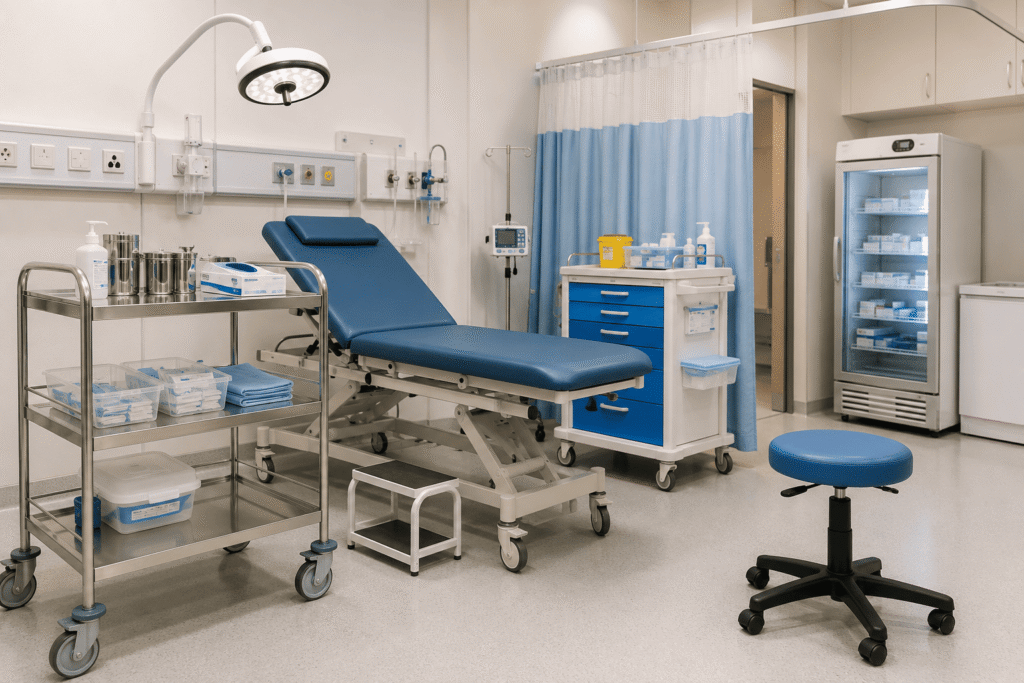
Medical trolleys are one of the highest-use items in any clinical facility. They move across departments, get cleaned multiple times a day, and carry everything from medications to wound care supplies to diagnostic equipment. The material specification matters enormously for long-term maintenance.
Stainless steel trolleys are the standard in high-use and high-contamination-risk areas. They resist corrosion, tolerate the cleaning agents used in healthcare settings, and rarely need surface restoration. Powder coated trolleys suit lower-intensity areas where aesthetics matter and the chemical exposure is lighter.
Getting this choice wrong in either direction creates cost: stainless steel in a low-use admin area is an unnecessary spend, while powder coat in a treatment room degrades under repeated chemical cleaning and ends up being replaced far earlier than planned.
| Trolley Type | Best Environment | Maintenance Consideration |
| Stainless Steel | Treatment rooms, clinical wards, high-traffic areas | Very low ongoing maintenance, corrosion-resistant |
| Powder Coated | Administration, reception, lower-use areas | Moderate, avoid abrasive agents, check coating integrity regularly |
2. Medical Examination Lights
Lighting in examination rooms is one of the most frequently underspecified items in a clinical fitout. Standard lighting gets substituted because it is cheaper. Then the globes need replacing every few months, fittings degrade from heat, and clinical staff make do with inadequate illumination because a maintenance request has not been actioned.
LED-based medical examination lights solve most of this. LED units run cooler, last significantly longer than traditional globes, and produce consistent colour rendering that matters during clinical assessment. The upfront price is higher. The maintenance costs over a three-to-five-year period are substantially lower.
There are several configurations worth knowing for different clinical settings:
- FlexLED lighting: desk and wall mount options suited to GP and outpatient rooms
- ULED lighting and ULED Plus: higher output for procedure rooms and multi-use clinical spaces
- PML1 and PML2 lighting: suited to environments where precision illumination and longer service life are the priority
Standardising on one lighting system across a facility or across multiple sites also reduces the spare parts complexity and training load for your maintenance team.
3. Curtain Tracks and Disposable Privacy Curtains
Privacy curtains are a significant infection control variable in ward and treatment environments. Fabric curtains that are laundered on a slow rotation are a known vector for cross-contamination. Disposable curtains, changed on a defined schedule, are more predictable from both an infection control and a cost management standpoint.
The track system matters as much as the curtain itself. A well-installed curtain track should function smoothly for years with minimal intervention. Poor track selection leads to glider failures, sagging, and the kind of minor but persistent maintenance requests that accumulate into real-time costs.
For facilities procuring at volume, disposable curtain systems effectively convert an unpredictable laundry and replacement cost into a predictable consumable line item. That shift alone can make annual budget forecasting considerably cleaner.
4. Medical Carts
Medical carts are used across nursing stations, procedure rooms, and clinical storage areas. The specification criteria that matter most for maintenance are surface material, wheel quality, and drawer mechanism durability.
Carts with antimicrobial surface properties hold up better to the cleaning protocols in healthcare settings and do not require replacement as frequently due to surface degradation. Wheels that lock cleanly and roll without resistance reduce the daily friction on clinical staff and the wear on the flooring. Drawer mechanisms that are robust to heavy daily use avoid the common situation where a cart becomes functionally unusable because a single component has failed and a spare part has not arrived.
When evaluating carts, ask for the expected service life from the supplier and check whether replacement parts are stocked and accessible in Australia. A cart that cannot be repaired becomes landfill. One with an accessible parts supply can be maintained for years.
5. Treatment Couches
Treatment couches take significant physical stress across a clinical day. They need to support patient weight safely, tolerate repeated surface cleaning with clinical-grade disinfectants, and maintain structural integrity over years of use.
The upholstery specification is the element that drives the most maintenance issues. Vinyl that is too thin splits under regular use and chemical exposure. Seams that are not properly sealed become contamination points that fail infection control audits. Padding that compresses unevenly creates pressure care risks and eventually a patient comfort issue that results in a replacement order.
When specifying treatment couches for a facility, prioritise seamless or minimal-seam upholstery, chemical-resistant vinyl grade, and a frame construction that can be cleaned underneath and around it easily. These details extend service life significantly and reduce both maintenance and infection control costs.
6. Vaccine Fridges and Medical Freezers
Cold chain compliance is non-negotiable for any facility holding vaccines or temperature-sensitive medications. Vaccine fridges and medical freezers that fail or drift outside acceptable temperature ranges create two problems simultaneously: a compliance event and a product loss that must be absorbed by the facility’s budget.
The maintenance cost associated with poorly specified cold storage is not just the repair bill. It is the cost of stock spoilage, the administrative work of a compliance incident, and in some cases, the patient care impact if a vaccine or medication is unavailable when needed.
Specifying units with proven temperature stability, auditable logging capability, and a local service network in Australia reduces the risk profile substantially. Units that require imported parts or specialist technicians who are not locally available become expensive liabilities when something goes wrong.
| Cold Storage Factor | Why It Matters for Maintenance Budget |
| Temperature stability | Reduces spoilage risk and compliance events |
| Local service network | Faster repair turnaround, lower downtime cost |
| Auditable logging | Supports compliance without manual monitoring labour |
| Correct capacity for the site | Avoids overloading, which accelerates wear |
7. Blood Stools and Clinical Seating
Blood stools used in phlebotomy and treatment areas are replaced more often than they should be, usually because the specification at purchase did not account for the actual conditions of use. Height-adjustable stools with gas lift mechanisms need to handle repeated adjustment across a clinical day. The upholstery needs to withstand regular disinfection. The base needs to be stable on clinical flooring and easy to clean around.
The same logic applies to clinical seating more broadly. Chairs with crevices, fabric upholstery, or complex base designs create cleaning difficulties that infection control teams flag repeatedly. Replacing these with appropriately specified clinical seating, even if it costs more at procurement, eliminates a persistent problem rather than managing it indefinitely.
A useful procurement rule: if a piece of seating requires a workaround to clean it properly in a clinical environment, it is the wrong specification regardless of the unit price.
How Specification Decisions Stack Up Over Time
The table below illustrates how the right furniture fitting accessories decision at procurement compares to a lower-cost alternative over a five-year period. The numbers are illustrative but reflect a pattern that facility managers will recognise from experience.
| Accessory | Lower-Cost Spec: 5-Year Cost Drivers | Higher-Quality Spec: 5-Year Cost Drivers |
| Medical trolleys | 2-3 replacements, surface degradation repairs | Minimal maintenance, no replacement |
| Examination lighting | Globe replacements, fitting repairs | Near-zero maintenance cost |
| Curtain tracks | Frequent glider failures, re-installation | Long service life, minimal intervention |
| Treatment couches | Upholstery repairs, early replacement | Extended service life with standard cleaning |
| Vaccine fridges | Temperature drift incidents, stock loss risk | Reliable performance, low intervention |
The pattern is consistent. The facilities that manage maintenance costs most effectively are not necessarily those with the largest budgets. They are the ones who make better decisions at the procurement stage and review those decisions on a planned cycle rather than waiting for something to break.
What to Ask Your Supplier Before Specifying
Before finalising any furniture fitting accessories for a new fitout or replacement cycle, these are worth raising with your medical equipment supplier:
- What is the expected service life for this product under the cleaning protocols we use?
- Are spare parts and replacement components stocked in Australia?
- What surface materials are recommended for our specific clinical environment?
- Is this product compatible with the cleaning agents on our infection control-approved list?
- What warranty terms apply, and what does the claims process look like?
A supplier who cannot or will not answer these questions clearly is telling you something important about how the relationship will work once you are a customer.
Conclusion
Maintenance costs in healthcare facilities rarely come from a single catastrophic decision. They build slowly from a series of underspecified products, each one creating a small, recurring cost that compounds over time. The furniture fitting accessories covered in this post represent categories where smarter procurement decisions have a direct and measurable impact on what your facility spends year after year.
The best time to make these decisions correctly is before a fitout or replacement cycle begins, with a clear brief, the right supplier relationship, and a total cost of ownership mindset rather than a unit price one.
About Sumac Medical Supplies
Sumac Medical Supplies is an Australian-owned business supplying a comprehensive range of furniture fitting accessories and medical equipment to healthcare facilities, aged care providers, and multi-site operators across Australia. From treatment couches and medical trolleys to vaccine fridges and examination lighting, we supply procurement and facility managers who need reliable products and fast Australia-wide delivery. As a trusted medical equipment supplier for clinical fitouts and ongoing facility management, we are equipped to support both single-facility and multi-site procurement requirements.
Planning a facility upgrade or replacement cycle? Browse the full furniture and fittings range or contact the team to discuss your facility’s specific requirements.
Frequently Asked Questions
- What furniture fitting accessories have the biggest impact on maintenance costs in healthcare facilities?
Medical trolleys, examination lighting, curtain track systems, and treatment couches tend to create the most maintenance spend when underspecified. Each of these items is used heavily across a clinical day, exposed to regular cleaning agents, and expected to function reliably without frequent intervention. Getting the material specification right for each one at the procurement stage makes a measurable difference to what a facility spends on maintenance over a three to five-year period.
- How do I choose the right furniture fitting accessories for a clinical environment?
Focus on three things: how the item will be cleaned in your specific setting, how often it will be used and by whom, and whether spare parts or replacement components are locally available if something goes wrong. Products that look suitable on a spec sheet can fail quickly in a high-use clinical environment if the surface material or construction does not match the actual conditions of use.
- Is stainless steel or powder coated the better choice for medical trolleys?
It depends on the environment. Stainless steel is the right choice for high-traffic clinical areas where trolleys are cleaned multiple times daily with hospital-grade disinfectants. Powder coated trolleys suit lower-intensity areas where chemical exposure is lighter. Using powder coated trolleys in a treatment room setting will result in surface degradation and earlier replacement than budgeted.
- How can a medical equipment supplier help reduce facility maintenance costs?
A good medical equipment supplier does more than fill orders. They can advise on material compatibility with your cleaning protocols, recommend products that have a proven service life in comparable facilities, and confirm whether parts and warranty support are accessible in Australia. That kind of input at the specification stage is worth considerably more than a small saving on the unit price.
- What should I look for in medical examination lights to reduce ongoing maintenance?
LED-based examination lights are the best option for reducing maintenance costs. They last significantly longer than traditional globe-based fittings, run cooler, and produce consistent clinical-grade illumination. Standardising on one LED system across a facility or multiple sites also simplifies your spare parts inventory and reduces the training load on your maintenance team.
- Are disposable curtains a cost-effective choice for healthcare facilities?
For most ward and treatment environments, yes. Disposable curtains convert an unpredictable laundry, cleaning, and replacement cost into a predictable consumable budget line. They also support infection control more reliably than fabric curtains that are laundered on extended rotation. The track system underneath still needs to be specified correctly, as poor track quality generates its own maintenance burden over time.
