
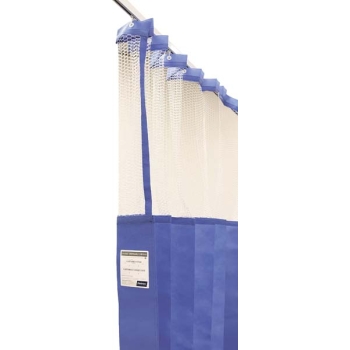
disposable medical curtains
Privacy Curtain Replacement Schedules: Infection Control Protocols for High-Risk vs. Standard Care Areas
Oct
Consider the last time you ever considered putting a gaze on the hospital privacy curtains that are suspended between hospital beds. They are innocent enough, eh? The problem is that most people do not know that the number of healthcare-associated infections that occur within Australian hospitals annually is close to 165,000, and the contribution of environmental contamination of the latter by such items as privacy curtains is a larger aspect that everyone ignores.
The replacement of the curtain within your facility is likely to feature somewhere in the bottom of your priority list until something happens. You’re already stretched thin trying to protect patients, stick to your budget, and meet infection control requirements that seem to change constantly. Different wards have completely different contamination risks, but who has time to track all that? The problem is, when an outbreak hits, those fabric dividers you never think about suddenly end up under the microscope.
Here’s where switching to disposable medical curtains actually makes your life easier instead of harder. You stop guessing about contamination levels and start following evidence-based replacement schedules that match each area’s real risk profile. We’re going to walk through when to replace curtains in different care environments, why disposable options genuinely improve infection control, and how to build replacement protocols that protect patients without burning through your budget unnecessarily.
Understanding Contamination Risks by Area
Here’s the thing, not every hospital area carries the same infection risk. ICUs, isolation rooms, and surgical wards need way more aggressive curtain management than your standard patient rooms or admin areas.
What we’re seeing in Australian healthcare facilities:
- ICU curtains start growing bacteria within 48-72 hours after you hang them
- Standard ward curtains typically get contaminated somewhere between one to two weeks
- Isolation room curtains need immediate swapping after every infectious patient leaves
- Emergency department curtains get hammered constantly because of rapid patient turnover
Once you understand these patterns, you can actually replace the resources where they’ll genuinely improve patient safety, just as proper PPE protocols reduce infection transmission, instead of just replacing everything randomly.
High-Risk Area Replacement Protocols
ICUs, burn units, and anywhere you’ve got immunocompromised patients demand your strictest curtain replacement schedules. These patients are so vulnerable that even minimal bacterial exposure can spiral into serious complications fast.
What actually works in high-risk areas:
- Swap out disposable medical curtains every 7-14 days whether they look dirty or not
- Replace immediately after isolation precautions or any known contamination incidents
- Use colour-coded systems so staff can visually track installation dates
- Schedule replacements during quieter periods to cut down on airborne particle distribution
Plenty of Australian hospitals now use disposable medical curtains exclusively in these zones because the infection control payoff justifies the cost when you factor in what outbreaks actually cost you and how they affect patient outcomes.
Standard Care Area Schedules
Replacement schedules can be extended somewhat in general medical wards, rehab units and outpatient areas without compromising adequate maintenance of proper infection control. These places typically cater to patients having a normal immune system and have a reduced risk of spreading infections.
Realistic scheduling options:
- Monthly replacement cycles handle most standard patient care areas fine
- Immediate replacement when curtains look visibly soiled or contaminated
- Post-discharge cleaning protocols that include checking curtain condition
- Do deep audits quarterly, assuring that your protocols are followed.
It is in these less risky locations that the transition to disposable medical curtains eliminates the unseen expenses and logistical hassles of laundering reusable medical curtains again and again.
Cost-Effective Implementation Strategies
Hospital administrators panic thinking frequent curtain replacement will wreck infection control budgets. But here’s what the numbers actually show, when you add up laundry costs, staff time, and what potential outbreaks cost, disposables often end up cheaper than traditional reusable curtains.
What you should actually calculate:
- Laundry services for reusable curtains run about $15-25 per curtain each cycle
- Staff time spent removing, transporting, and reinstalling adds labour costs nobody counts
- Healthcare-associated infections cost Australian facilities thousands per incident when they happen
- Disposables eliminate cross-contamination risks during laundering and transport entirely
Do the math on total ownership costs across 12 months including everything that’s hiding in the shadows before you decide disposables cost too much.
Building Your Facility Protocol
Curtain replacement programmes only work if staff can actually follow them during crazy shifts. Overcomplicated systems get ignored every time, but simple visual tracking methods stick.
What you actually need:
- Date tags on every curtain showing when it went up and when it’s due for replacement
- Stock management ensuring you’ve always got enough curtains in all sizes on hand
- Staff training on removal techniques that don’t spray pathogens everywhere
- Full compliance audits and scanning where to adjust things
Write your protocols concisely and review them quarterly on the basis of real infection control statistics and what your workforce reports to you on what is working and what is not, similar to how proper equipment maintenance protocols protect critical medical supplies.
Ready to Improve Infection Control?
Buy Quality Disposable Medical Curtains from Sumac
FAQs
- What is the suggested frequency of replacement of ICU privacy curtains?
Disposable medical curtains should be changed after every 7-14 days or immediately after contamination events in high-risk areas, such as ICUs. - Is it cheaper to use disposable curtains than to have reusable curtains laundered?
Yes, disposables do save money when you correctly weigh-in the cost of laundry, the time of the staff and even the risk of infection. - What replacement schedule works for standard patient wards?
Monthly replacement cycles work well for standard care areas, with immediate changes whenever you spot contamination. - Can the same curtain stay up if a room remains empty?
No, even empty rooms need scheduled replacements because environmental contamination keeps building up.
